Max Planck Institute for Legal History and Legal Theory
Special Legal Orders Normative Diversity in the 19th and 20th Centuries
Research Field
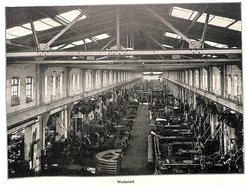
The company as a special order: Factory of Zeitzer Eisengießerei und Maschinenbau AG (1919)
The company as a special order: Factory of Zeitzer Eisengießerei und Maschinenbau AG (1919)
The legal history of the 19th and 20th centuries is characterised by a remarkable ambivalence. On the one hand, it was the time of large-scale codifications, mostly based on the principle of the equality of the users of law, which regulated broad areas of life in a consistent manner. This law aimed at universality represented – at least to both practitioners and scholars of law – the legal system. On the other hand, already existing or newly developing social differences and the functional differentiation of modern society required an increasing number of new regulations regarding specific groups or domains. Further differentiation was the result of the state's expanding its claim to regulate in other areas, too, above all in the sphere of social and economic policy. New regulatory needs also arose from scientific and technological progress. The latter led both to the differentiation and specialization of state law itself and to the creation of autonomous or semi-autonomous special legal orders.
Numerous fundamental questions of modern legal history are connected to these opposing movements towards universality, on the one hand, and increasing differentiation, on the other. How did state law seek to accommodate these developments? What non-state legal systems emerged? What role did particular religious, cultural, technological, socio-political and economic rationalities come to play in legal or regulatory systems? What special judicial orders developed? Did new concepts of law and normativity emerge? The Research Field brings together projects that explore these questions by examining specific sectors or groups, or that focus on contemporary jurisprudential reflection on these special orders.
Ebbertz, M.: Arbeitsordnung und Strafbestimmungen – Betriebliche Normenproduktion nach dem Betriebsrätegesetz 1920. Arbeit und Recht 2024 (3), pp. G5 - G8 (2024)
Wolf, J.: "Women as Workers". Discussions about Equal Pay in the World Federation of Trade Unions in the Late 1940s. In: Through the Prism of Gender and Work. Women’s Labour Struggles in Central and Eastern Europe and Beyond, 19th and 20th Centuries, pp. 202 - 230 (Eds. Çağatay, S.; Ghiț, A.; Gnydiuk, O.; Helfert, V.; Masheva, I. et al.). Brill, Leiden; Boston (2024)
Regola-zione. Dimensione giuridica. Filosofia politica (1),
S. 101-116 (2024)
4.
Collin, P.; Casagrande, A. (Eds.): Law and Diversity: European and Latin American Experiences from a Legal Historical Perspective. Vol. 1: Fundamental Questions. Max Planck Institute for Legal History and Legal Theory, Frankfurt am Main (2023), IX, 759 Seiten pp.
Collin, P.: German Discourses on Autonomy from the Beginning of the 19th Century Until Today. In: Law and Diversity: European and Latin American Experiences from a Legal Historical Perspective. Vol. 1: Fundamental Questions, pp. 547 - 567 (Eds. Collin, P.; Casagrande, A.). Max Planck Institute for Legal History and Legal Theory, Frankfurt am Main (2023)
Collin, P.; Casagrande, A.: Introduction. In: Law and Diversity: European and Latin American Experiences from a Legal Historical Perspective. Vol. 1: Fundamental Questions, pp. 1 - 36 (Eds. Collin, P.; Casagrande, A.). Max Planck Institute for Legal History and Legal Theory, Frankfurt am Main (2023)
Collin, P.: Ambivalenzen des Schiedsgerichtsverständnisses im späten 19. und frühen 20. Jahrhundert – Das Beispiel der Schiedsgerichte der Sozialversicherung. Zeitschrift für Neuere Rechtsgeschichte 45 (3/4), pp. 212 - 233 (2023)
Wolf, J.: Cross-Movement Strike Actions: Works Council and Communist Groups at the Bremer Vulkan Shipyard in the 1970s. Journal of Labor and Society 26 (2), pp. 103 - 132 (2023)
The Limits of Equality: Special Law in the Age of Legal Monism in Italy (19th–20th Centuries)
In: Law and Diversity: European and Latin American Experiences from a Legal Historical Perspective. Vol. 1: Fundamental Questions, S. 467 - 500 (Hg. Collin, P.; Casagrande, A.). Max Planck Institute for Legal History and Legal Theory, Frankfurt am Main (2023)
10.
Härter, K.: Insane Offenders, Dangerous Criminals, Criminal Responsibility and Security Measures: The Positivist Criminology Network and the Reform of Criminal Law in Imperial Germany. Glossae: European Journal of Legal History 20, pp. 68 - 94 (2023)