Non-state law of the economy. The normative order of industrial relations in the metal industry from the Empire to the early years of the Federal Republic of Germany – a digital source edition
Research Project

The project is part of the joint project “Non-state Law of the Economy: the normative order of industrial relations in the metal industry from the Empire to the early years of the Federal Republic of Germany”. In the source collection, sets of rules are edited that show the normative diversity of the world of labor and how it has changed over time. On the basis of this documentation, the hitherto little-known non-state normative order of industrial relations can be reconstructed for a period of about 100 years.

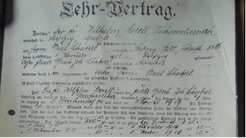
The source collection comprises internal work regulations (Fabrikordnungen, Arbeitsordnungen) or company regulations with socio-political relevance (e.g. relating to company health or pension insurance) as well as rental contracts of company flats. Furthermore, the project explores the variety of collective bargaining agreements, as well as individual agreements between employers and employees, as shown in the example of an apprenticeship contract between the company Wilhelm Marell, Tachometerwerk Leipzig, and its future apprentice Paul Schubert from 1914.
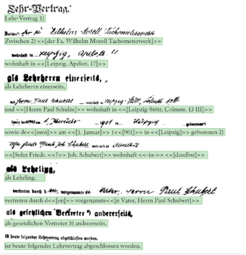
To create the digital edition, we collect the sources in various archives and then optimize them for computer-assisted processing. We work with Optical Character Recognition (OCR) software and subsequently manually edit handwritten entries and deletions (as illustrated in Fig. 2). The material is then categorized using selected terms (tags) to enable detailed source analysis.
The aim of making these currently dispersed and not easily available materials accessible in a single collection is to provide a basis for further research by legal, economic and social historians.