Negotiating the order. Works councils in the Weimar Republic
PhD Project

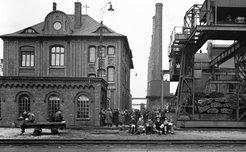
Gelsenkirchen der Gutehoffnungshütte, Mai 1927.
Quelle: Weichelt, Karlheinz: Schalke. Alte Bilder erzählen, Erfurt 2013. Abdruck mit freundlicher Genehmigung von Karlheinz Weichelt und dem Institut für Stadtgeschichte Gelsenkirchen.
The profound change in the world of work has recently led to a renewed interest in the history of the diverse forms of workers' participation. While varying in approach, this research often shares a narrative of crisis that assumes an erosion of the democratic constitution of the workplace. Thus, there has been a renaissance of interest in the diverse forms of a (re)democratisation or (re)humanisation of industrial relations, however concretely conceptualised.
It is noticeable that non-historical research in Germany has repeatedly used new methods and approaches that have hardly been taken up by historical co-determination research for the period before 1933. Furthermore, historical research today deals primarily with the period after 1945. One of the reasons certainly lies in the lack of sources for the pre-war period. However, the absence of studies on "Betriebsräte" (works councils) in the Weimar Republic focusing on the micro-level of the workplace is rather surprising. This dissertation project aims to fill this gap by investigating the practical arrangement of works constitution in a company in the metal industry in the early 20th century in Germany. In the Weimar Republic, the mandate explicitly belonged to the non-state actors, the collective bargaining partners at the micro- (workplace) and meso- (unions and employers’ organisations) levels, to self-regulate industrial relations collectively within the framework of state regulation.
The history of workplace co-determination in the Weimar Republic cannot simply be studied emanating from the Works Councils Act 1920 (or other legal regulations). It must be considered as a process of norm building at the level of the workplace, in which several actors, especially non-state actors, are involved. My dissertation project thus also contributes to legal-historical questions posed within the research field of Special Legal Orders in the project “Non-state Law of the Economy”. Another aim of this joint project is to build up a digital collection of sources. This will allow the detailed research results to be put in a broader context, thus adding a horizontal dimension to the vertical investigation. At the same time, the numerous normative sources found during my research will contribute to the digital edition.
The company is not merely the arena of conflicts mediated along capitalist class structures. But class is nonetheless divisive in this context, unlike in many other modern types of organisation. The factory is characterised by an ambivalent tension between cooperation and coercion. If one assumes a fundamental conflict at the heart of factory-based production, then the question is not whether workplace conflicts were regulated at all, but how they were regulated. The German model of the dual system of interest representation is thus instead a variant within the Varieties of Capitalism of the organisation of industrial relations, not an exception. This is supported by comparative and global studies, which clearly show the multi-normativity of historical and contemporary constellations of industrial relations.
Following the praxeological understanding of the company as a field of social action and the concept of the company case study, this dissertation project will examine the practice of norm production and industrial relations in three different regions of Germany in the GHH/MAN Company. The Gutehoffnungshütte was a large corporation, mediated via a headquarters, but subdivided and decentrally structured with a regional focus on Westphalia and Bavaria. In terms of sources, the project draws on works council minutes, internal correspondence, work regulations, internal statistics and business records. In addition, other external sources will be consulted occasionally.